Oct 21, 2019

Quality writing

I’ve written before about the process that takes place when I write: how the writing simply appears.

My writing?

I call it “my writing.” but is it? How could it be “mine” when “I” didn’t do it? I sat and invited it, and it appeared.
“Well,” you might say, “you had to sit your body down for it to appear. You had to open your computer. You had fingers on the keyboard and allow your fingers to type the words that come. If you had not done these things, the writing would not have appeared.”
“Perhaps,” say, “but why call it ‘mine?”.
Perhaps there’s a reason. I call it mine, not for my own benefit, but for the benefit of others.

Quality writing

There’s a lot of writing out there. Some is good. Some is not. The difference, as I wrote, is Quality.
The writing that appears in front of me has a certain Quality. It the initial Quality is not sufficient, then I decide not to accept it and decide to wait for something closer to the Quality that I want to arrive.
The writing that appears in front of other people (or that “they” might say that “they” “write”) has a different Quality. So to label some writing as “Mike’ Wolf’s writing” is to say that it has the kinds of Quality associated with other “Mike Wolf” writing.
I’ll go with calling it “my writing” if only for that purpose. But I didn’t write it. I just filtered it for Quality.

Are congratulations due?

“Then I shouldn’t ever congratulate you on a good piece of writing, or an especially thought-provoking idea,” you might have said.
Indeed, you would certainly have said it if your name had happened to have been Daniel, and you had been chatting with me about this in a Hangouts channel.
“You can congratulate me,” I might have and did reply. “I did sit down. I did tune in. I did decide what had enough Quality and what did not. It’s like congratulating the head of a publishing company for the kinds of books it publishes, or the head of a record label for the music they put out. You can do that.”
“The fact that I don’t do the writing doesn’t mean I have no part in its creation. I’m essential. But just not in the way you might think.
That’s what happened here.

Oct 19, 2019

Solving for X


Photo by Taylor on Unsplash
When you are discontent with your life’s conditions, you can follow one of three strategies:
You can change your mind so that you don’t remain discontent—or the dissatisfaction becomes less severe.
You can change your behavior so that you no longer experience the conditions that cause discontent.
You can change the world around you, so those discontenting conditions no longer exist.
These are not exclusive strategies.
You can do more than one.
The question is: if X is what must to change to remove the discontent, how can we solve for X?

Changing your mind

It’s always possible and sometimes easy to change your mind And sometimes merely changing your mind can be a complete and satisfying solution.
But not always.
Sometimes it’s just the first step. Changing your mind will almost make it easier to change your behavior and change the state of the world.
You might not want to change your mind, but if changing your mind would make it easier to change things beyond your mind, then changing your mind would be an excellent place to start.
You might believe that you can’t change your mind. But if you believe that, then it’s just because your mind’s been conditioned to believe that it can’t be changed.
The belief that there’s nothing you can do is called “Learned helplessness.”
And it can be unlearned.
To change your mind, solving for X means finding what it takes for you to change your mind.
X is you.

Changing your behavior

The conditions of your life are partly the result of accidents and partly the result of the choices you’ve made. Your circumstances are the result of your past behavior.
Your behavior has a cause. It’s the product of your mind. So to change your circumstances, you must change your behavior, and to do that, you must first change your mind.
And not just any change will do. It must be a change that leads to behavior that will change your circumstances.
If you’re trying to change your behavior, solving for X means finding what it takes for you to change your mind so that your behavior changes in the way that you want it to change.
Once again, X is you.

Changing the world

The state of the world is not the product of your mind. It’s the result of the laws of nature and of the actions of other individuals.
The world will not change of its own accord. Some individual must do something to change the world.
You cannot directly control what others do, but you might influence them indirectly. But only if you do something different from what you have done in the past.
Since the way you’ve behaved in the past has not caused others to behave in ways that make the state of the world closer to the way you prefer it, you have to change your behavior and interact with others more effectively.
And to change your behavior to what it has been to what might bring about the state you desire, you once again need to change your mind.
Solving for X means discovering how you might influence others to change what they do; that means changing the way that you interact with them, and that means changing your mind.
Once again, X is you.

No way around changing your mind

The only way to change the circumstances of your life is by changing your mind and your attitude, or your mind and your behavior, or your mind and others’ behavior by changing your mind and your behavior.
You are the only one who can change your mind.
You are the only one who can change your behavior—and you do it by changing your mind.
You are the only one who can bring about a change in the world—and you do it by changing your behavior, and you do that by changing your mind.
No matter what course you take, when you solve for X, X is you.

You still have choices

X is you, but you’ve got choices.
You can choose to change your attitude or leave your attitude unchanged and change your behavior and try to change the behavior of others.
You can change your behavior by using more skill or by using force.
You can influence people by finding common interests and negotiating with them or by wielding power and bullying them.
There’s no one way to solve such a problem once you’ve realized that it’s yours to solve.
When you solve for X, X is always you.

My ideal

I’d like always to be able to change my mind in whatever way would result in the greatest good and the least harm.
I can’t always know the best way to do that, but I can generally get a good idea.
And I haven’t always been able to change my mind—even when I’ve known how I want it to change—but practice has made me increasingly able to do so.

Oct 18, 2019

Applied mindtravel--a how-to guide

A while back I wrote this post: Mindscapes and mindtravel
Today I discovered I’d written a how-to guide and never published it.
Easily fixed.

Building the itinerary

Get a notebook (or start a document).
Whenever you have a moment of feeling really good, record it in the notebook. Date, time, something memorable about it. Give it a name. Whatever might help you get back there easily.
Once in a while, remember some great places you’ve been. Add it to your list of places.

Imaginary destinations

You can create imaginary destinations, too.
Invent them and put them in your notebook and travel to them just as you can to “real” ones. Maybe you’ve got some already. I’ve got a few.
Hey, it’s your mind, after all, and you get to decide what in your mind you want to call real.
Since it’s all imaginary anyway, you get to choose.

Practice

Periodically, pull out your notebook or list and practice mind-traveling back to those places and times.

Mindtravel to safety

Once you’re good a mindtravelling, you can mindtravel to safe places from shitty places.
Here:
  1. Remember you can mindtravel
  2. Remember a good place to go to—or pull out your notebook
  3. Mindtravel there.
  4. Enjoy the experience and then mind-travel to another and another.
  5. Do that until you feel like it’s unlikely you’re going to be being snapped back to the shitty place
Then carry on.

A historical note

I found a draft of this post my StackEdit files.
Did I post it? Or didn’t I?
East way to find out. Search the blog. Turns out I posted something like it:
Mindscapes and mindtravel
Complete it or delete it, right?
And then a victory lap.

Oct 17, 2019

Celebrate every success

A recent post, Victory laps: complete it or delete it, was about victory laps. This one is about training my brain and creating systems.
Turns out, I’d come across a variant of the advice—“take a victory lap” earlier. I’d written about it here
I’d watched a video on “reinforcing goal-directed habits’ (here) that compares training q brain to training a dog. You can’t train a dog to step on a particular square unless the dog’s reward for doing it closely follows the dog’s action. You can’t train yourself to write a term paper when the reward comes months later.
Instead, reward yourself every step of the way. Good sentence! Good paragraph! Nice edit!
Why not. (Good sentence!)
I said: (Good!)
What he said made a lot of sense. I write, and write, and write, and never give myself the kind of enthusiastic reinforcement that he recommends.
What he’s doing is conditioning himself. And I realized that I need to recondition myself.
So I did. I went to a different place to write, worked hard at debugging myself, changing my behavior and rewards, and managed to get six posts written—and posted.
Repeat: and posted. That’s a month of typical work. And I felt great!
Good quote!
And then what happened? (Good question!)
Amazingly, with such success behind me, that practice disappeared. (Good!)
WTF?
This post: Why all productivity systems stop working explains it in part. The other part is this: productivity notions don’t work until they’re turned into systems. (Yes!)
My blog seems to be full of good practices that I’ve learned—or maybe not learned. Maybe just encountered and recorded. They could have been turned into productivity systems. But they were not.
Maybe it’s time to learn the things Past Me has encountered and recorded and turn them into systems.
I could make a regular practice of rereading what Past Me has written and put some of his hard-won insights into regular practice for the benefit of Future Me.
(Yay! Time to get this wrapped up and posted.)
(Victory lap, coming up)

Oct 16, 2019

Quality

In this post, Being, doing, having, I wrote about what happens when writing appears:
Then, after the writing appears, I read what has appeared. And then I judge its quality.
Quality!
That’s what it is.

Zen and the Art of Motorcycle Maintenance

From out of the depths of the unconscious appears a memory of Robert M. Pirsig’s book, Zen and the Art of Motorcycle Maintenance (ZMM). I’ve read ZMM several times. Or several Past Me’s have each read it once.
ZMM and Pirsig’s other book Lila are about quality. Or, as Pirsig says, Quality. With a capital Q.
What is Quality?
I know what Quality is to me. You know what it is to you. So does Pirsig.
Quality is what’s important.
In his books, Persig describes what he calls his Metaphysics of Quality (MOQ). Here’s part of the description, from Wikipedia:
Quality,” or “value,”… cannot be defined because it empirically precedes any intellectual construction of it, namely due to the fact that quality (as Pirsig explicitly defines it) exists always as a perceptual experience before it is ever thought of descriptively or academically.
Quality is the “knife-edge” of experience, found only in the present, known or at least potentially accessible to all of “us.” Equating it with the Tao, Pirsig postulates that Quality is the fundamental force in the universe, stimulating everything from atoms to animals to evolve and incorporate ever greater levels of Quality.
According to the MoQ, everything (including ideas and matter) is a product and a result of Quality.
So quality is all around us. And we know it when we see it. And it is the fundamental force in the universe.
Works for me.

Quality writing

I don’t cause the words that appear on the screen to appear. I sit. I intend. They appear.
But after they appear—and sometimes as they appear—I read them. And here’s where I do something. I make decisions.
I make Quality decisions.
If the writing that appears has “insufficient Quality”—and I know what that means—then I intend that something better appears. Then I wait for it to appear. If I’m typing, I wait for my fingers to make some words appear. Words with greater Quality.
Lather, rinse, repeat until what manifests has sufficient Quality. Then I may move to publish it.
If I don’t get the necessary Quality, I may abandon what I’ve started.
But that’s all that I do. I’m a Quality gatekeeper.
I say: this has enough quality to post.
And so I will.
And then, a high-Quality victory lap.

Victory laps: complete it or delete it


Daniel and I have a regular call, once a week, for about an hour.
Sometimes there’s some catching up—but most of that happens in the chat channels we’re in.
The weekly calls are usually about more substantial stuff. What’s happening in our respective lives that needs reflection. What we’re doing—or not doing.
Sometimes I come with a problem, and he’s a good listener and an insightful coach. Sometimes it’s the reverse.

Yesterday’s problem

Yesterday was my turn
to whineto articulate a problem.
It was my usual issue: I’m not getting done the things that I want to get done, writing in particular.
Daniel asked some excellent questions, a few I’m still chewing on. Then he and offered a great suggestion: when I finish a piece of writing, take a victory lap.
So I did, and then I did.
I wrote Circus, circus.
Quietly, because Bobbi was sleeping.
And man, did it feel great.

The problem

For the record, the problem was this:
I love writing. As I have written so often I’m not going to link.
The process of finishing a piece of writing—checking the grammar, the formatting, and so on, has become bearable, thanks to my work on coming up with a better process. See Authoring, improved.
But the end of the process is still a slog. And when I finally push the publish button—if get to that point without quitting—my energy is at its lowest ebb.
Later, when I’ve recovered, my Future Self will be glad that his Past Self pushed through and published.
But on the evidence, most Future Selves have not been glad enough to endure the slog.
Finishing a piece of writing is a joyless task, and that joylessness seems to have back-propagated.
(Question for Future Me: does it have to be joyless? Probably not.)
So my selves have been quitting earlier and then not even starting.
“Next time, take a victory lap,” Daniel suggested. “Really celebrate.”
I recognized immediately it was the advice I needed.
Thank you, Daniel!
Later, I realized that Past Me had given me advice a lot like that.
And I’d forgotten it.
Probably because I didn’t make a practice of it.
And probably because, as Past Me wrote, all productivity systems stop working
I made a commitment to Daniel (and for and on behalf of Future Me) to get rid of a piece of inventory every day.
Ideally, finish something that had been started and not completed.
Acceptably, delete something that wasn’t worth completing.
Complete it or delete it!
My new mantra.
One of.
So I did it.
And then, that victory lap.
Man, that felt good.
And I know it’s going to feel good when I do my lap after I publish this one.

Oct 15, 2019

Circus, circus

After my junior year at MIT, I decided that I’d had it. I was off to see and save the world. The first part of the story, in which I hitchhiked to Chicago and spent a whole day looking for the perfect job will appear someday. A link to the draft, in Google Doc form, is at the end of this post, just case I die before I get around to it.
At the end of my day in Chicago, I had no job and no place to sleep. I’d been hoping that I would have run into a generous prostitute like Jamie Lee Curtis in “Trading Places,” who’d give me a place to sleep so that I didn’t have to confront finding a place myself. Plus sex. But she never appeared. Desperate, I called a fraternity brother who lived in Indiana, got an invite, and hitchhiked to his place.
I don’t remember much about getting there or the night I arrived. I think there was some conversation, a good meal, and some needed sleep. The next morning I was back to seeing and saving the world. First, I needed a job.
I was too lame to find a job in Chicago with millions of jobs available. So how was I going to find one out in the Indiana sticks?
Luckily the circus was in town,

Circus, circus

In those days, “the circus” meant the one-of-a-kind Ringling Brothers Barnum and Bailey Circus that played for weeks in big cities.
But that wasn’t the only circus around. There were a bunch of smaller circuses that played smaller towns, and as luck would have it, the Mills Brothers’ Circus was right where I was—and looking for talent.
The Mills Brothers circus visited towns in and around BFE. Unlike Ringling Brothers, which played for weeks in each venue, Mills Brothers put up their tents in the morning, did a show or two, took them down after the last show, and headed off to the next town overnight.

The circus! The circus!

The circus! The romance of the circus! When I was a kid our rich uncle Jack would treat Mom and us kids, once a year, to a fabulous day in New York that usually included the circus. Once we went to the then-famous Trader Vic’s restaurant—and when the Maitre d’ welcomed Uncle Jack by name, I knew I was in the presence of royalty. “My Uncle Jack is the president of GMC,” I’d tell my friends in grade school, not mentioning that GMC was Ginsberg Machine Company, one of the largest suppliers of sewing machines in New York. Never mind that! Uncle Jack got us front row, center, balcony seats for The Circus (Barnum and Bailey was ‘The Circus’ he way New York was ‘The City.’) The circus! I’d be living a dream.
So we headed down to the fairgrounds to see if they would hire me. And they did! I had all the necessary qualifications to work for the Mills Brothers’ Circus: I wasn’t dead, and I wasn’t in jail.
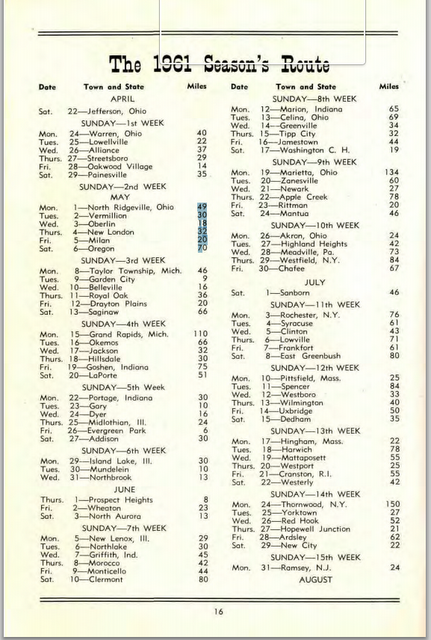
The Mills Brothers’ Circus was an old-time circus: we worked under the big top, a new city nearly every day. Here’s a page from their 1961 route book, located here.
We worked six days a week every week. On Sundays, I heard people would chip in and rent a hotel room so that we could get showers. It sounded romantic, but only because I was really stupid.
I imagined my new life starting with my lowly job in the circus. I’d rise from there to unimaginable heights.
Right.
I didn’t last to Sunday.
The pay was kingly: I got 35 cents per hour, a place to sleep, and three “meals” a day. The meals were nutritious enough to sustain life, and you could eat as much as you wanted because you didn’t want that much.
The cooks were creative and economical. Lunch was soup made by dumping whatever people hadn’t eaten the night before in a big pot of water and boiling it. For all I know, they also boiled whatever had ended up in the trash or was left on peoples’ plates.
If you stuck with them then entire season and traveled back with them to their winter quarters in Florida, you’d get a bonus. I don’t remember what it was, but it was significant. And it had to be because no one who had a better choice would ever want to spend an entire season working for the Mills Brothers Circus.

Getting outfitted

When I left Boston, I didn’t pack clothes for working at the circus. I’d been anticipating a job in an office environment, and shirts and suits made no sense. So we went downtown, and I got a workman’s uniform—the kind that delivery truck drivers used to wear back in the day before hippies and rock bands caused the dress code to deteriorate to the point that people could wear whatever the fuck they wanted.
All duded out in my new work uniform.. I joined the circus.
They put me to work right away on props. As each act came on, we had to haul out what the act required, then haul back the stuff they left in the ring after they were done. Some acts needed special equipment—like trapeze or high wires. So we’d haul out the contraptions, attach them to cables that hung from the top of the big, then haul on the other end to lift up the gear and get it into position, check for safety, and then the act went on.
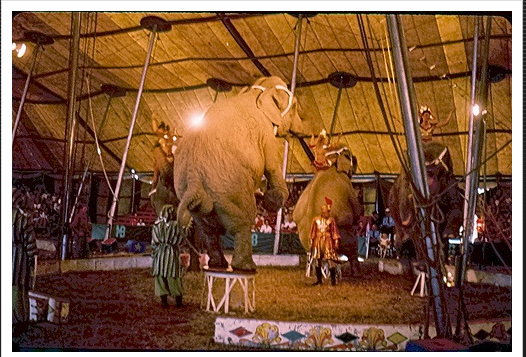
Here’s what things looked like when the show was on:
Yes! We had elephants. For more pictures of the Mills Brothers Circus, amazingly enough from 1963, check this out.

The parade

The show started with a parade. Beautiful young women in sequined costumes! I was sure that one of the beautiful women would eventually fall in love with me, and we’d travel the road of life together. But then reality set in. I learned that the beautiful women were the daughters of circus families from traditional cultures, and they didn’t let their daughters talk to any of the lowlife scum that did the dirty work. I was a lowlife scum.
So one more naive dream went down the tubes. Maybe that big-hearted prostitute would come to a performance and take pity on me.

Elephants galore

We had elephants!
Elephants meant two things: beautiful women riding them and never talking to me and elephant shit for me to clean up.
We had horses! With beautiful women who would never talk to me riding them and horse shit for me to clean up.
There were clowns and acrobats. There was no clown shit or acrobat shit. So that was a win.

Lions and tigers and no bears, oh my

The big event was the wild animal act. We assembled a metal cage that filled the center of the ring, then lined up the animal cages outside in a big train. It looked like this:
We’d roll the animal cages into the ring and attach the first one to a gate in the center ring and each to the next behind it. Each of the rolling cages had a gate each end. We’d raise the gate in the cage nearest the ring and poke cat if it didn’t run out. Then we’d open the back gate in that cage and the front gate for the one next in line, and prod the next cat forward and into the ring. After the act was over, the cats would be released from the ring in reverse order, and we’d lock them into their individual cages, then pull the whole train back to where the cats lived when not performing.
Oh yes, very important. Right before the show, we fed the cats. A lot. We didn’t want hungry cats dining on lion tamer in the center ring of the Mills Brothers’ circus.

Wrap up and bedtime

At night, after the last show, we’d take down the big-top, collapse all the poles and stick them in trailers. By then, it would be dark. Time for bed.
Bed was a hard wooden pallet covered with a quarter-inch mattress in the back of a semi. I had six truck mates. One of them seemed to have tuberculosis and coughed all night. It was hot out, and the trucks didn’t have fans for circulation much less air conditioning. Just open doors at the back of the truck to let in the night air. And the mosquitos.
Around two in the morning, the big doors were closed (and presumably bolted), and the circus left for the next town.
There is a big difference between the springs in a bus or a car and the springs in a truck. Basically, it’s the difference between springs and no springs. Add bumps to no springs and a wooden pallet with no mattress and stifling summer heat and a tuberculotic bunkmate and no windows, and you have a perfect recipe for no sleep.

The next day

We arrived in the next town just before dawn—about 5AM. The truck doors were opened, and the long workday started. Now we had to pull out all the crap that we’d packed away the night before, raise and guy the main poles, lay out the tent. Hook it up. Then out came the elephants who pulled the big top up. No shit. Elephants.
Then we had to put up the small poles, fasten the bottoms of the tents to spikes that we’d driven into the ground with sledgehammers, and finally, we got to eat. Or rather ‘eat.’ Circus’ food’ deserved quotes.
I remember two other things about my short time working there. One was the guy who was in charge of all us roustabouts (great word that)—a guy called Mother John. Mother John was gay and not effeminate and submissive, but aggressive and a scary to the pretty boy I was back in those days.
Mother John, the Internet tells me, was (Mother) John Makinson, who assisted John (Louisiana) Lewis and worked with John (Shorty) Walker. Don’t remember Louisiana or Shorty, but Mother John clearly left an impression on the internet. For more history, see here.
I stayed to take the tents down that night, but I couldn’t face another night in the truck. I collected my meager pay from Mother John and decided that—well, maybe I should finish school. So I hitchhiked back home to Baldwin.

Hitchhiking back

The outbound trip took one ride. The return trip took many. I’d hitchhiked to school and back for a couple of years, so I knew the do’s and don’ts. I always tried to get let off near a busy ramp where cars are going slowly enough to be willing to stop, and there were enough cars that I didn’t have to wait all day. But somehow on that trip, I caught in the middle of some nowhere place where there were damned few cars and none willing to stop.
I landed there because one of the guys who picked me up started talking and asking about sex too much, and I asked to be let out without considering the difficulties of getting my next ride.
I got picked up by another guy who either had the most fantastic career of anyone I’d ever met, or who was a pathological liar. I think the latter. I got out of his car at a rest-stop on the Pennsylvania turnpike.
I remember two other rides, neither from that trip. One was a trucker who shared some of his life experience with me and gave me advice that I thought was good, and that stuck with me: no matter how upset I got, never to walk out on my lady unless it was for good and forever. There were times when I got angry with one girlfriend or another, and his advice always came back to me, and I hung in.
The other was a guy in whose car I left my wallet, and who had the grace to put it in the mail and send it to me, cash intact. Some people are awfully good.
When I got home, my Dad and Mom were glad to see me and didn’t make me wrong for taking off, wasting the investment that they’d made in my education, and spoiling their dream of seeing me graduate from MIT.
Ingrate that I was, I found a way to spoil part of that dream. I graduated a semester early, and they didn’t get to see the ceremony,
Excerpted from this document

Pages