Aug 26, 2019

Modems and memories

A few days ago, a friend mentioned Galacticomm and their bulletin board system the Major Bulletin Board System.
From the depths of memory, my CompuServe account number and password appeared. And that led me (and now you) on this trip down memory lane.

BBS Systems

BBSs were a big thing once upon a time. Those of you who have only lived in the internet age may find the history of connectivity interesting. Or boring. Whatever.
You could create a BBS system if you had a PC, a bunch of phone lines and an equal number of modems. You might want to start with a PC with a lot of memory. Instead of the 640 KB standard limit, you could get a Phar Lap memory expansion that moved you up to 16 Mb.
That’s megabytes, kids. Not gigabytes. Wow!
Each phone line and modem gave one user access to your system. With a standard PC you could support—well, two users.
But with specialized hardware, you could get up to sixteen.
Sixteen users! At once. All you needed was 16 phone lines and 16 modems.
Wow!

CompuServe

My CompuServe account number and password were. 72520,2747 and GENUS/BUREAU.
Where did that come from? Where had they been hiding? Could I have remembered them if I’d tried? No idea.
But here’s the CompuServe story.
You connected with CompuServe by dialing a local access number, sticking your phone’s handset in your modem’s acoustic coupler.
Acoustic coupler? Don’t know what that is? Acoustic couplers looked like this:
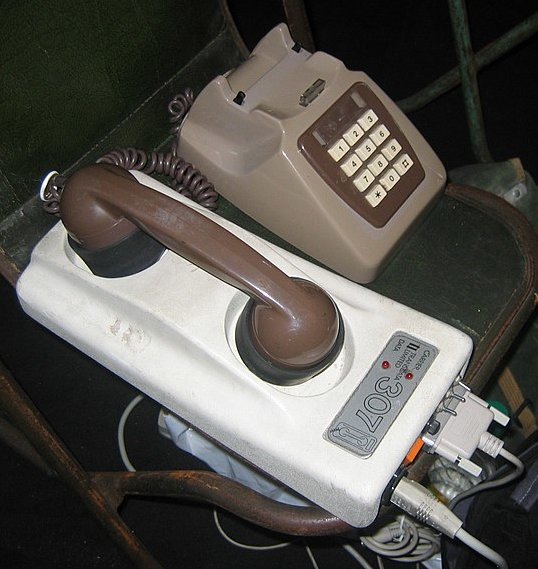
I was an early adopter. I think my first modem was 110 baud. What’s a baud? A baud is roughly a bit per second. At higher baud rates, you can transmit more than one bit per baud, but we never reached them. DSL modems today might.

Doing the math

How fast is 110 baud? If each character takes 8 bits, 110 baud is 825 characters per minute. Some of those characters are channel control, so the effective speed is less. And if your phone line is noisy, even less. But let’s be optimistic and think that it’s about 800 data characters per minute.
An average person can read at more than 200 words per minute—roughly 1000 characters per minute. I’m well above that. So my first modem under best conditions was much slower than my reading speed. Probably slower than yours since you are probably above average.
And images? The picture of the acoustic modem isn’t that big Just 75Kb. That’s 11 ½ minutes at 110 baud. And the megabyte images we’re used to? Don’t wait up.

Faster and faster

Things changed.
Can you imagine how excited we were when the modem standard jumped to 300 baud? Three times as fast. Then, just a few years later to 1200 baud? Four times as fast? Then to 9600 baud. My first 9600 baud modem was big—about 16 inches square and one or two inches high and it cost more than $1,000. And that’s when $1,000 was real money.
Eventually, speeds got up to 56K and sizes went down. 56K modems were on a chip in your PC!
Astounding, right?

Music to my ears

When modems connected, the modem board would let you hear them negotiating protocol, and once they agreed, the board would shut off the sound. If they didn’t, then the sound would go on forever.
This is the sound of progress as modems got faster:
And here’s the full experience for a high-speed modem:

The sound of silence

The sound of modems connecting was music to my ears.
But the sound of silence meant you were connected.
Nothing better than the sound of silence.

Aug 3, 2019

Choose the God you believe in--and choose wisely

You can choose the God you believe in. Or you can choose to believe there’s no God. It’s your choice.
There is a fact of there matter. There may be a God. There may be many Gods. There may be no God. What you choose may be correct (consistent with the fact of the matter), or it may be wrong.
But it’s still a choice.
The Marketplace of Religions offers prepackaged Gods to believe in. Many come complete with rites and rituals, instruction books and storybooks, customer testimonials, gathering places, and communities of the like-minded. For those who choose no God, the Marketplace also offers prepackaged agnostic and atheistic belief systems, many with their own accessories.
Within any belief genre, individual believers, leaders, and groups customize the generic offering to meet their own needs and desires and to the demands of the Marketplace for innovation within the confines of brand identity.
The Marketplace gives everyone a lot to choose from.

Is it a choice?

Most people don’t consider that someone can choose what to believe—much less choose which God to believe in; and if they think belief a choice, they don’t think they can make that choice; and if they think they can make it, they don’t exercise their ability. Most people were taught (or more accurately, conditioned) to believe in a particular god, and they never break that conditioning. They accept the choice that was made for them by their parents and other ancestors.
But the God you believe in is undoubtedly a choice. The question to answer isn’t “Is it a choice?” but “Whose choice?” Your choice? An ancestor’s choice? Your community’s choice?
Make it your choice.
And choose wisely.

Choosing wisely

How do you choose wisely?
My answer is: choose the God and choose the practices that will help you to live the best life that you can live. When choosing a God, as in all things, “Believe not what is true, but what is helpful”
If you’ll live your best life being watched by a vigilant and intolerant God who threatens to torture you eternally or burn you to a crisp, then, by all means, choose that God, and live your good life under that God’s pitiless gaze.
If you’ll live the best life being under the loving eye of a God who accepts your failings and forgives your shortcomings, and teaches you the lessons that you need to in order you live the life you desire, then by all means, choose that God and live your good life in that God’s loving embraces.
If none of the prepackaged Gods suit you, you can choose to be creative: design the God that will serve you best, choose to believe in that God, and then act according to your belief.

For me, it starts with gratitude

I am grateful for the circumstances of my life. I’m grateful for the talents and abilities I’ve been given. I’m grateful for other gifts: personal characteristics, tendencies, and opportunities, for intelligence and for health, without which I would not have developed the other gifts I have been given into what I now possess.
I’m grateful for my very existence, for the existence of a world full of beauty and for the ability to see that beauty.
With all the gifts I’ve been given, none of them earned, it would be ungrateful not to say thank you.
But who shall I thank? Shall I thank the laws of physics? Shall I thank the process of evolution? Shall I thank the dark, and cold, empty and uncaring universe from which I emerged?
I need to give thanks, and I’ve chosen a God to receive my thanks. That God is as glad to receive my thanks as I am to offer them.

The God I’ve chosen

The God I’ve chosen is the perfect parent and the perfect friend.
That God is always there for me, available whenever I want company, full of love.
It is a God that forgives my mistakes and encourages me to forgive others as I’ve been forgiven, that loves me and encourages me to love as I’ve been loved.
The God that I’ve chosen doesn’t want me to obey, but to think; to do what is right because it is right and not because I fear Godly or human punishment; to educate myself so I can intelligently decide what is right.
The God that I’ve chosen doesn’t want to be worshiped, but to be loved and respected as one would love and respect a worthy parent or true friend.
The God that I’ve chosen loves and respects me in return.
The God I’ve chosen is the perfect God for me—by design.
That God may exist only in my imagination, but that’s real enough and good enough for me.
And it’s good enough for God.
PS: I believe that God helped me write this. I am certain that any errors are my own.
Click here to subscribe to 70 Years Old, WTF! by email.

Jul 31, 2019

The Tohunga Lounge and the Writers Nook


Photo by Aaron Burden on Unsplash

The Tohunga Lounge and the Writers Nook

A while back, my friend JL ran an experiment in community building. He’s a wicked smaht guy (as they say in Boston) and he knows other really smaht guys (and gals.) He set up a Slack workspace called the Tohunga Lounge (Tohunga is the term the Māori people of New Zealand use for “really smaht person.”) JL started posting interesting content and inviting the Tohungas he knew to join and contribute.
I thought his idea was brilliant, and I told him so. I was enthusiastic. But after a while, I dropped out. The Tohunga Lounge became an attractive nuisance for me because of the mental afflictions that beset me.
I have AMD, IDD, EIFID, and TMTOMHD. This toxic combination makes me hyper-vulnerable to intellectually seductive content. For those who don’t know these TLAs, FLAs and SLA’s: AMD is Attention Management Disorder, IDD is Intention Deficit Disorder (each of which I’ve written about) EIFID is Everything Is Fucking Interesting Disorder, and TMTOMHD is Too Much Time On My Hands Disorder (about which I may write.)
(TLA, is, of course, the self-referential TLA for Three Letter Acronym. And if you can’t figure what an FLA and SLA are, you should be reading a different blog.)

The knowledge creation vortex

When a person like me with AMD, IDD, EIFID, and TMTOMHD comes across something interesting (hint: everything is fucking interesting, due to EIFID) and since I know that my purpose in life is to create knowledge I’m easily sucked into a knowledge creation vortex. Step 1 is knowledge acquisition and Step 2, if I ever get to it is remixing what I’ve acquired, because Everything is a Remix (video, site) and you need to acquire knowledge to remix it.
Once I’m in a vortex I will only emerge when (a) something more interesting catches my attention and sucks me into a neighboring vortex or (b) one of the obligations that I desperately try to avoid catches up with me, or (c) I fall asleep exhausted, or (d) I remix the acquired knowledge and make some new knowledge—like this blog post, or (e) something else that I can’t think of right now happens.
To deal with my AMD, IDD, EIFID, and TMTOMHD I quit reading Reddit (to which I am nonetheless indebted for one of the best ideas I’ve come across) and stop reading Twitter (which led me to another really good idea), and stop reading Facebook (link to a page of photos of .well, you can guess from the URL) (which has not yielded any ideas that I can recall and which still manages to waste time every time I go there to check on one of my kids who posts there) and I turned off my Google news feed (which about as much a waste of time as Facebook.)
And even though the quality was better than any of them, I stopped visiting the Tohunga Lounge. Sorry, JL.

Tohunga 2.0

But now JL has launched Tohunga Lounge 2.0, hereinafter “TL2,” or “TL” or “the Lounge,” (as lawyers and pseudolawyers like me say.) TL2 is based on Basecamp. I’ve used it before, and it’s a much better platform. I’m a big fan of founders Jason Fried and DHH and who gave birth to a new way of running a business 20 years ago and who wrote ReWork—a book about their business philosophy. DHH was a driving force behind Ruby on Rails and is the author of this screed about business models.
Within TL2, JL has created the “Writers Nook” hereinafter “the Nook.” or “WN.” I like the Nook.
Everything in the world manipulates us. Some things manipulate us in ways that harm us. Others, in ways that benefit us. JL and TL2 and WN seemed like they are manipulating me in a good way, by exploiting my euproductive proclivities.
And here’s some evidence: this blog post.

Euproductive proclivities

It might be useful to identify the said (as we say) proclivities. Useful to me, at least. Maybe for you.
Here they are, in the order I thought of them.
First, is routine: the Nook features nag-o-matic (thanks JL for automating, thanks Past Me for inventing.) I expect nag-o-matic will send me an email every day and remind me to write. I think it will help.
Next is accountability: other people in the group will see if I did or not write. If no one else, JL will see.
Then there’s community: writing is a lonely business, and it’s nice to be lonely together with other lonely people. That’s why I like writing in coffee shops. But the things that qualify as Coffee shops in Blue Hill are not that conducive to writing.
Then there’s novelty. I jump into new things with enthusiasm. Sticking with them, not so much. But nag-o-matic and accountability and community may overcome that tendency. At least I hope so.
There’s support. I might ask for support from other people, but to me, support means my love for supporting other people. I’ll do things to help other people in ways that I won’t do for myself.
Then there’s gratitude: I live in a state of more-or-less continuing gratitude for gifts unearned.
So here I am with about 1000 words behind me. I’m grateful to JL for including me in his circle and for inviting me to his creation. And giving me someone to be accountable to and creating a community.
And for nag-o-matic, 2.0.
Hey, nag-o-matic, I wrote something today.

Jul 24, 2019

What really happened in Paris?

Part I

“I don’t know if it’s possible to take that shot and get the stars in one go, must be a composite. Several hundred maybe. What do you think?”
“Right. No chance it’s a single shot.”
“Holy shit, you guys. Are you kidding? You don’t remember? Justin, did you actually forget that?”
“I forget everything.”
“Yeah, but you wouldn’t have forgotten that, would you?”
“Probably. There’s always something more interesting in the now. Pictures of the then are interesting though.”
“OK, c’ mon, seriously? You don’t remember?”
“No.”
“Daniel, you don’t remember, either?”
“I’m not sure what you’re getting at.”
“You were there. Both of you. With me. In Paris. That night that we took that picture. You guys really don’t remember?”
“When was this supposed to have happened?”
“Last night. No. It was the night before. Maybe the night before that. I don’t remember exactly. Within the last week, for sure.”
“I was in Hawaii.”
“I was in Boston.”
“Still, we met up in Paris and took that picture. Justin, you brought the camera. Daniel, you were the one who actually took the photo. You guys really don’t remember that?”
“No.”
“No. Not only that, it couldn’t have happened last week as you say. I told you. I was in Hawaii. It takes fifteen hours to fly to Paris. Thirty hours round-trip minimum. I took lots of photos while I was in Hawaii. My photos are date and time-stamped. I’ll bet I’ve got a photo that shows I was in Hawaii during every twelve-hour period. So I couldn’t have been in Paris last week.”
“You could have been there if it took less than twelve hours.”
“Yeah, but it’s impossible to make the trip faster.”
“It’s not impossible. There’s a calculable probability that you dematerialized in Hawaii and rematerialized in Paris, took the picture, and then reversed the process. So not impossible.
“Technically, you’re right. It’s not impossible. But the probability is close to zero.”
“Sure, but so what? The probability that you exist is close to zero. The probability that I exist is close to zero. The probability that Justin exists is close to zero. Even given that we exist, the probability of this conversation is close to zero. And yet that hasn’t stopped it from happening.”
“But it’s not happening. This is just a story you’re writing about it happening. And you’re just a character in your story.”
“Well if I’m a character in a story then so are you. Are you going to deny your own existence just to prove you can’t have been in Paris? Nice try! But you’re as real as I am and as real as Justin is, and as real as this conversation is.”
“In the first place, I’m not Daniel, I’m Justin. He’s Daniel.”
“No, I’m Justin.”
“You are? I thought I was Justin. Do you want to be Justin instead?”
“It’s not a matter of wanting to be Justin. I am Justin.”
“Fine. If you’re that stuck on being Justin, you can be Justin. I’m flexible enough to be either Justin or Daniel, even if you’re not.”
“Guys, guys, it doesn’t matter. The point is, we were in Paris, and we took that picture.”
“No, we weren’t”
“Then how come I remember it? I couldn’t remember it if didn’t happen, could I?”
“You’re pretending to remember.”
“Well, I say you’re pretending not to remember.”
“I’m not pretending. It didn’t happen.”
“It did.”
“No. It didn’t”

Interlude

“Let’s just take a step back and look at this rationally. Why does it matter what story you choose to believe about the way that photo came into existence?”
“I don’t choose what story to believe. I believe what’s true. If I’m not sure, what’s true, I say I’m not sure. If I know something is not true, I don’t believe it.”
“So you don’t have free will?”
“What?”
“If something you know that something is true, then you’re compelled to believe it. You can’t choose not to believe something true, and you can’t choose to believe something that’s not. Right?”
“Why would I want to believe something that isn’t true?”
“What if you were facing a task you’d attempted in the past and consistently had problems doing. What would you believe would happen the next time you did it?’
“I’d believe that I’d have the same sorts of problems.”
“Supposing I hypnotized you so that you believed that you’d done it successfully many times. What then?”
“Hmm. There’s a good chance that I might do better. I might also be overconfident and do worse.”
“Supposing I conditioned you against overconfidence. Effectively, I moderated your expectation—your prediction, if you will—that you’d do badly.
“I’d probably do better.”
“So being hypnotized into such a belief would be helpful?”
‘I suppose so.”
“Even though it’s false to fact?”
“I suppose so?”
“So would you let yourself be hypnotized whenever you faced such a challenge so that you’d do better?”
“No.”
“Why not?”
“I’d be giving up my free will. I’d be putting the hypnotist in control.”
“But you’ve already given up your free will. The belief that you’ve failed many times already makes it likely that you’ll fail. And if you can’t choose—on your own, and without a hypnotist—to believe something that would more helpful, then that belief is controlling you. Why not, as I wrote, ” Believe not what is true but what is helpful?
“I can see that using a hypnotist would replace one form of control with another. So I’d be willing to use a hypnotist.”
“What about changing beliefs on your own. What if you believed that a magical being had granted you the power to do well on that task. What do you believe would happen then?”
“There are no magical beings. So I wouldn’t believe it.”
“So your belief that there are no magical beings keeps you from believing something that would be helpful. That belief is in control, not you.”
“But it’s true that there are no magical beings.”
“Sure, it’s true. But so what? If you can’t choose to believe in things that don’t exist, then reality holds you hostage. Every creator believes in things that don’t exist until they make them exist.”
“Yes, but there’s a difference between believing in things that don’t exist and things that can’t possibly exist.”
“But everything you can imagine can exist. The probability may be low, but it’s still possible.”
“When I use a word,” Humpty Dumpty said in rather a scornful tone, “it means just what I choose it to mean — neither more nor less.”
“The question is,” said Alice, “whether you can make words mean so many different things.”
“The question is,” said Humpty Dumpty, “which is to be master – – that’s all.”

Part II

“Well? Did we take that picture together or not?”
“Of course, we did! It was a hell of a night!”
“Yes. It was so great seeing you there.”
“Let’s do it again sometime.”

Jul 4, 2019

When we're a wake


Photo by Zbysiu Rodak on Unsplash Pun by Mike Wolf on Hangouts
For reasons that I think will be fun to figure out, I’m delighted by this pun.
Q: When does water reach the highest level of consciousness?
A: When it’s a wake.
Why?
By some reckoning, I am the creator and pride of authorship explains my delight.
But that’s not true.
I was there, and I can tell you that’s not what happened.
I have no pride of authorship. Only delight in the pun’s existence.

How it happened

I’ll start this story at the moment when the idea that a pun using “awake” and “a wake” might be funny appeared.
Where did that idea come from? I don’t know. It was just there. It appeared in consciousness, like everything else, as if by magic.
So I had this idea—this intention to make a pun. The punch line was clear in mind: “When it’s a wake.” And an old joke appeared in consciousness: “When is a door not a door? When it’s ajar.”
So the pattern that arose was “When is some kind of water not that kind of water.” But nothing good appeared. Then an metaidea about the consciousness of water appeared.
Specific ideas matching that metaidea appeared, and I—or my mind—said “no” repeatedly. Until the one that’s written appeared, and got a “yes.”
So that’s how it happened.

A more comprehensive story

But how did that initial idea appear? And where did the desire to turn that intention into a pun instance originate? And what produced the mechanism that did the work? To answer those questions, we need to start earlier.
13.75 years ago, the universe exploded into existence. It was the Big Bang.
For about 9.25 billion years the matter in the universe evolved. It started as almost pure hydrogen with a little helium. Eventually, it cooled enough to make stars. After billions of years they went nova and produced all the elements needed to make our sun, and the other things that go around our sun, including the planet where I’m writing this. And eventually me.
It took some time.
Once the planet was formed, it took a few billion years fo cool enough for life to appear. And then it took about 3.75 billion years of biological evolution to get to me.
Biological evolution is tough. It’s hard for the survivors and deadly for the rest. Along the way there’s pain and suffering and death. But eventually I was born and began to evolve.
It took more than 76 additional years of evolution for that pun to appear. It would probably not have arisen but for an evolving interest in meditation and the evolution of a small community of people who would appreciate the intended pun once it appeared.
Why would they appreciate it?
Why would I think that they would?
The answer to this—and all other questions—is the same: 13.75 years ago the universe exploded into existence and…it’s the way that the universe evolved.

My enjoyment

I enjoy that pun. As soon as it appeared, I was filled with delight.
Why?
In some sense, it makes no sense. It’s not a great work of art.
Yet, I believe that it pleases me nearly as much as anything I have ever created would please me.

The mysteries and the magic

So these are all mysteries.
How did the intention appear?
How did the pun appear?
How did I know that others would like it?
Where does all this come from?
What is making my fingers type this sentence?
It all just appears. As if by magic.
I live in a universe filled with magic.
You too.
The potential for that pun must have been inherent in the quantum states of particles after the big bang. It just took a lot of time and rearranging of matter to get it out.

The purposes of the universe

Yesterday one of the purposes of the universe was fulfilled: that pun appeared.
Today another purpose was fulfilled: this post appeared.
Was it worth it?
Absolutely.

Jul 1, 2019

Quantum Computing
A universe in a photon

In my last post, From Farnam Street to Quantum Computing, I
threatenedpromised to write about.
Quantum Country, a new kind of book that happens to be about quantum computing.
This morning I meandered over to Quantum Country and learned something so delightful and astounding (to me) that I had to write about it.

The short form

You can encode either a zero or a one in a classical bit.
In a quantum bit (qubit) you can encode an almost infinite amount of information.
Really!
One qubit in a photon could contain the universe.
Of course, there’s a practical problem. But never mind. It’s possible.

The details

In everyday computing, a bit has a value 0 or 1. In quantum computing, a qubit has a value
α∣0⟩+β∣1⟩
Where ∣0⟩ is the computational basis state, analogous to the classical 0 state, and ∣1⟩ is the computational basis state analogous to 1, and α and β are complex numbers. α and β can take on any values, provided that
∣α∣2+∣β∣2=1.
What do α and β mean?
Well, that’s tricky.
But one interpretation is that they give the probabilities that, when measured, the qubit will yield a classical 0 or 1.
The probabilities are, respectively ∣α∣2 and ∣β∣2.
α could anything. It could be a string of digits like 0.113117097110116117109032099111109112117116097116105111110032105115032097119101115111109101
which could be decoded to the string quantum computing is awesome.
Alpha could also be a much, much, much longer string that could encode the entire current contents of the World Wide Web.
The point is: a single qubit could encode anything.
In theory.

The problem

There are just three problems.
The first: it’s exponentially (or worse) difficult to encode increased amounts of information in a qubit.
The second: once you’ve got it a known state, it’s tough to keep it there.
And finally, once you’ve got the information encoded, it’s impossible to find out what it was.
But never mind that! See this qubit here? It could contain all the secrets of the universe.
Isn’t that cool?

Actually, there’s something there…

Like matter and energy, information can’t be created.
As David Deutsch says, knowledge is a particular kind of information. So all the knowledge that the world has obtained so far—whether in books or in DNA—must have been present at the beginning of the universe, in the remnants of the big bang.
All the knowledge of the universe—all the knowledge that could ever be obtained, inefficient encoded—must have been there in the beginning. It’s just taken all this time to decode it.
Deutsch argues that we can construct a world like our own out of any sufficiently large (multiple-star-sized) amount of hydrogen.
And in that world, intelligent creatures could evolve.
And they could do science and collect knowledge comparable to and transcending our own.
So all the knowledge that we have and could obtain must be encoded in any sufficiently large amount of hydrogen.
Must be.
I’m not saying it would be easy to decode it.
But it’s possible.
And here I am, surrounded by all the knowledge that has ever been and will ever be.
And maybe even made out of it.

Pages