Jan 8, 2016

Predictions

save image
I have several predictions to make. First prediction: Three days from now, on January 11, 2016, I will write a post that has, at the top, the same image as I have at the top of this one.

I predict that on that day I will have started writing something about what I did today, January 8th, But as I start to write it I will realize something more interesting. So I will stop writing about this day and instead write about my realization: I am a cyborg. I predict that I will title this future post "I am a cyborg. And Google helps me remember my life."

If I were writing about January 8th even a few days from now, on January 11th, I'd have a hard time remembering what I'd done on today day. It was not a terribly eventful day. Even if I were (as I seem to be) writing on January 8, I'd have forgotten a lot in the course of the day.

Such are the failings of human memory that I predict I will write about on the 11th.

But fortunately, I have Google Timeline to remind me. Without its help I remember that we drove from Boston to Winchester Virginia. I remember that we had dinner at an Outback Steakhouse, and with a little thought I would have remembered that we stayed at a Red Roof Inn. But there are things that I could not remember without a little prompting. And there are details that are utterly lost.

Details come back as I consult the timeline on the map. And the couple of pictures that I took that are interleaved on the timeline on the sidebar. I thought it was funny that it was a TBACK Steakhouse (OUTBACK with missing letters) for example. Unlikely I'd remember that.

All this reminds me that I want to take more pictures, even of mundane things like sandwiches (which I predict I will do later) that my frail human memory is incapable of recovering.

It reminds me that I bought a Narrative Clip just so that I would take pictures by default, not by exception. It reminds me that I brought it with me and that I intended to start using it.

I predict that on the 11th I will dig it out and try to start using it.

I predict that I will now press Publish.

Jan 7, 2016

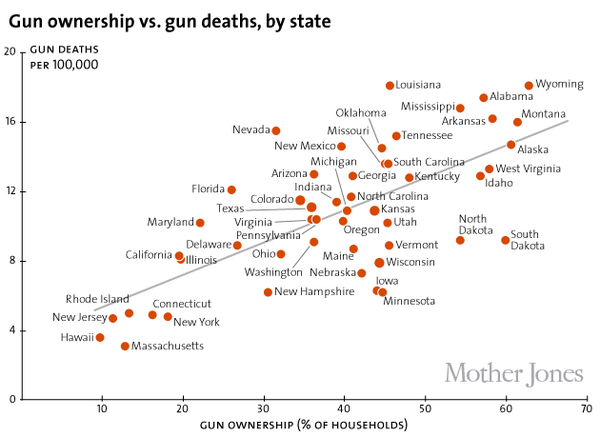
A while ago I came across an article (here) that included this graphic:

I checked the data and it passed the initial smell test, so I posted it to on the site of a discussion group that I belong to, here.

Someone who is smarter and more diligent than me, did a deeper dive, and found out some interesting things. 

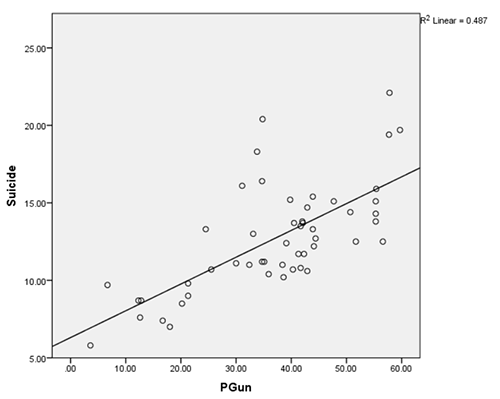
Gun deaths is "gun suicides" plus "gun homicides." Here's what the gun suicide graph looks like.


Seems like there's a pretty clear correlation between more guns and more gun suicides. And if I was anti-gun (I am not, by the way) and if gun owners are going to off themselves in increasing numbers the more guns, then that's fine with me.

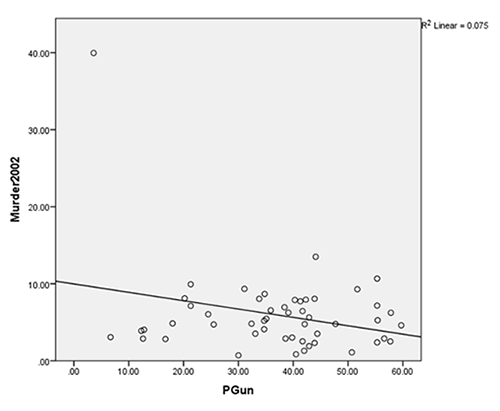
But if you pull the gun suicides out of the gun deaths numbers you end up with this relationship for gun homicides: 


To the extent that there's any trend, it's one that shows that more guns implies less murder.

That's just the beginning. Scott Alexander at Slate Star Codex has done a more complete analysis. Link here. It's worth reading, just to see how this sort of thing ought to be done.

Jan 6, 2016

Deep practice and yak shaving

I just finished reading "The Talent Code" by Daniel Coyne. His book is  based on his analysis of what people have done and need to do in order to become great at something. First: they need "ignition." They need to believe that they can become great, and be inspired to be great. Second: they need "master coaching." A master coach knows what skills are needed for greatness, what practices are needed to build those skills, and how to connect a particular student to the skills and practices that student needs. Finally, and most important, is "deep practice."

Deep practice is not mere repetition. Mere repetition is mindlessly carrying out a conditioned response. If the conditioned response results in a shitty performance, then instead producing a shitty performance, but only with great effort, one can produce a shitty performance with ease. Deep practice, means that you constantly compare the current performance (shitty, say) and the desired, or ideal level (awesome, say) and continuously analyze and adjust the performance to make the current performance more like the ideal. For deep practice you must have the ideal in mind and a burning desire to move in that direction (ignition) and it helps to have someone who can point out differences between current and ideal that you are not capable of noticing and who can give you exercises to help you build your skills (master coach.)

I found Coyne's book because Barbara Baig, a master coach for writing, mentioned it in her book, "Spellbinding Sentences."   She's believes in what Coyne calls "deep practice" and what others call "deliberate practice."

Athletes and musicians who want to become great devote countless hours to what the expertise researchers call “deliberate practice.” This is not just fooling around, or playing a game with a friend. Deliberate practice is highly focused and intentional. It’s designed in such a way that we can learn a new skill or improve one we already have. Anders Ericsson, an expert in skills acquisition, says deliberate practice “entails considerable, specific, and sustained efforts to do something you can’t do well—or even at all.” It’s deliberate practice, not innate talent, that makes some people great at what they do. 

I attended a talk that Barbara gave at the Blue Hill Library some years ago. She'd just published her first book, "How to be a writer," in her talk she introduced some of the ideas in the book: breaking writing down into a set of skills; providing exercises to develop each skill. Her first book is about "content skills:" finding and organizing something to write about. The second book is about "word skills:" building your ability to put words together so that you can clearly and compellingly present your content.

Practice! Practice! Practice!

I believe in it. We did some of her practice exercises. I found them useful.

So I bought the book. And .... I did nothing.

Nothing.

Not a fucking thing!

Reading "Spellbinding Sentences" turned into a yak-shaving adventure. Want to write? Get  Barbara Baig's book. Start reading it. She mentions Daniel Coyne. Get his book. Start reading it.

Lather, rinse, repeat.

I'm going to start making my practice deliberate. Tomorrow, I'm going to do two things. One: I'll read Baig's book up to the first relevant exercise, and I will do it. B: I will start a log so I can record things that I learn as I continue my 100 day challenge.

And now, Publish.

Jan 5, 2016

Writing plan, 2016

Photo credit: dmelchordiaz via Foter.com / CC BY-NC-ND

Until yesterday I thought the biggest writing problem that I had was sitting my ass in the chair and starting. Now I realize it's much different than that. And I think I know what I need to do.

It's 9:04 am.  I am doing my pages as I have done them so many times before. 750 words of whatever comes to mind. But this time with a difference.

The difference is that I am not just writing, but trying to stay "awake" while writing.

For me writing is a complex, conditioned response. The stimulus is sitting down in front of a piece of paper or a computer, intending to write. The response is when a part of my brain makes my fingers move and... Voila! Writing appears. Kind of like now. Then. Whatever.

Conditioned response writing. Not me.

Normally I would just let the conditioning write. It does a good job. From time to time I might wake up and watch the writing happen. But waking up is not necessary. Just sit down. Writing will happen.

Then, before pushing the publish button I'd wake up and read what the conditioning had produced. Why? Because I don't push the button often enough to have conditioned that response. And because I want to do a read-through before pushing the button.

So I read what I've written. First time through, I'd almost always decide that the writing needs improvement. That decision would be a stimulus. It would invoke another part of my brain, one conditioned as an editor. The editor would change some words, maybe move a paragraph. And then it would have the writer rewrite whatever the editor felt needed rewriting. I'd go back into my trance.

Next time it was "ready to publish" I'd wake up again. I would read it and decide it was better, but still not good enough. I'd go back to sleep. Stimulus would invoke editor and writer yet again. And again. And again. Until publication or exhaustion.

I've been doing this unwittingly for years. I thought that my problem was getting myself to sit down. If I solved that, I'd solve it all. But there's more to it.

Because I've been making "improvements." The word "improvement" means: new conditioning. The conditioned writer writes in response to the "sitting down to write" stimulus and periodically some stimulus causes a conditioned critic, the "improvement," to go to work. It responds to its stimulus by reviewing the writing, and when the writing does not meet the critic's conditioned standards, it invokes the editor which makes changes and causes rewriting. All automatic. I am unnecessary.

It works. Read my other posts, if you don't believe me.

The whole process is thoroughly automated, except for sitting down. And I'm trying to automate that.

WTF? More conditioning!

Don't get me wrong. There's nothing wrong with conditioning. It gets the job done. Which is awesome.

And conditioning can improve, which is also awesome. But by itself conditioning improves only within the limits of other conditioning -- let's call it my self-improvement conditioning. Which is also awesome. Lots of people don't self-improve and haven't conditioned themselves to self-improve. But its limited.

To go beyond those limits takes more. Takes me. Assuming, of course, that I exist and have free will.

That's a detail. Let's assume it's true.

And that leads me to the plan for this year, for 2016.

The plan is a combination of more stimulus, more conditioning, more attention, and more supervision.

This morning when I sat down at my computer, there to greet me was a blank 750 words page. A stimulus trap I'd set the night before. As planned, it invoked the AutoWriter, and AutoWriter started writing. Credit where due: most of this post was written by AutoWriter.

From time to time it was reviewed by AutoCritic. Credit where due, AutoCritic was great at pointing out places where it needed work.

So it was edited by AutoEditor. And then rewritten by AutoWriter.

And how, here it is.

My intention as all this was going on, was to keep waking up and getting involved. Paying attention to what AutoWriter, AutoEditor, AutoCritic were doing, and offering small bits of direction.

I'm trying to coach AutoWriter and AutoCritic and AutoEditor to go beyond their current conditioning.

I'm tryin', Ringo. I'm tryin' real hard to be the coach.

It's a doomed effort, in a way. The more I coach the more I'm creating AutoCoach.

Some day AutoCoach will do coach almost as well as I do.

Then, I guess it will be time for MetaCoach.

It's 12:51 PM, by the way.

Jan 4, 2016

An experiment, not a resolution

And now for something completely different.

New Years is the time for resolutions. I've been there and done that. And failed. Resolutions, New Years and otherwise, haven't worked too well for me. I hear that they don't work too well for most people. Maybe you. If so, maybe this will help.

Here's why I think they don't work for me. Some background.

I've been writing and thinking a lot about the experience of "waking up" -- realizing that I've been going through life in a waking dream, watching my life live rather than actually living it. For example, I wrote about it here.

That's led me to realize that when I'm in the non-awake state, what's living my life is not me, but instead my (excellent) conditioning. It's lived by a simulated human being. I wrote about that here.

And I've argued that if change is possible -- other than change caused by the environment, which is yet more conditioning -- then it can only happen during those (short) periods of time when I am actually present. Awake. Making decisions. Able to exercise free will. Here.

Resolutions don't work for me because that's how I'm conditioned right now. There's a good chance that most of "my" New Years resolutions are the direct result of conditioning. After all, you're supposed to make resolutions on New Years, aren't you? Conditioning.

But suppose I, and not my conditioning, have made a resolution. What happens then?

Answer: conditioning. Under normal circumstances the automated machinery is quite adequate, thank you very much. In a crisis, an event that entirely exceeds my conditioned ability I might show up and make some critical decisions. But then -- well, my conditioning can take over.

But there's a problem.

I'm conditioned to not waste time or energy unnecessarily. And I'm conditioned to make rational decisions. And I'm conditioned to tolerate and to be forgiving of lapses and mistakes. So if there's a lapse, and the only consequence is that I've saved time and energy, then it's irrational to continue to waste time and energy, by continuing to do something that I don't really have to do. Right?

And so, once things leave crisis mode, I'm back to default mode.

To get myself out of default mode I've got to do one of three things. A) I must re-condition myself or B) I've got to put myself in an environment where doing what I decided to do takes less time and energy than avoiding it, or C) I must stick around and be present all the fucking time.

All the evidence shows that C is impossible for me right now, and may be impossible forever. The best that I can hope for is being present more frequently and for longer periods. And I am working on that. Lordy, I am working!

A) is only possible when I'm around to recondition myself, or when I'm in an environment that will condition me in the right direction. And therein lies my plan for change.

Right now as I am writing this, by virtue of what I'm writing, I keep reminding myself to wake up. And so I am more awake than usual, and that means I can work on my conditioning. Which I am doing right now.

So here's the experiment: to recondition myself by making sure that I show up tomorrow before today's conditioning is lost, and deepen the conditioning. To create an environment that makes it easier for me to keep going than to stop. Those two things together might make the groove deep enough. I did it for a few years with 750 words without understanding what I was doing.

So now I think I have a better understanding. This is day 7 of the current streak. I need to make sure that I wake up before 24 hours have passed.

I need to create an environment where waking up is easier.

Pages